Why generic AI upscaling models ruin e-commerce conversions (and how to fix it)
When a shopper visits your store, a blurry product photo cuts your conversion probability in half. Here is why generic AI upscalers fail on e-commerce textures, and how we built a specialized model to fix it.
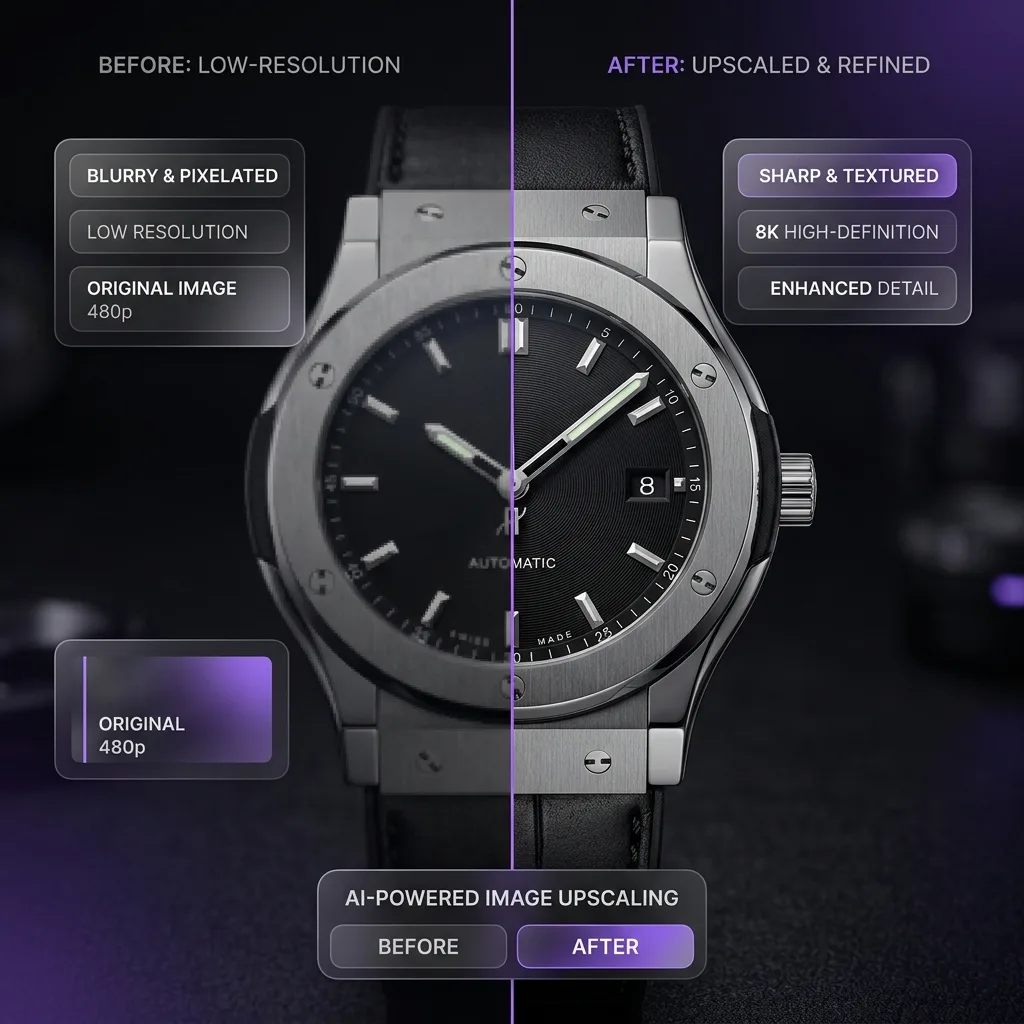
When a shopper visits your store, a soft, low-resolution product photo cuts your conversion probability in half. Here is why generic AI upscalers fail on e-commerce textures, and how a texture-aware approach solves the problem.
Most merchants understand that low-resolution images hurt sales. The common reflex is to run those images through a generic AI upscaler like Midjourney or basic Stable Diffusion.
This usually makes the problem worse. The image looks sharper, but the product looks fake.
Why generic AI upscaling fails on e-commerce textures
Generic diffusion models are trained on everything from anime illustrations to landscape photography. When you ask them to upscale a 480p photo of a leather watch strap, they don't know it's a leather watch strap.
They see a pattern of pixels and guess what should fill the gaps.
This leads to the "plastic wrap" effect. The model smooths over fine grain, turning brushed steel into flat gray polygons and rich leather into shiny vinyl. The resulting image is high-resolution, but it no longer accurately represents the physical product.
When a customer receives an item that lacks the premium finish they saw in the photos, your return rate spikes.
The scatter-gather approach to preserving material fidelity
To fix this, an upscaling model needs to understand material context before it touches a single pixel.
We built a two-stage pipeline for our upscaling engine.
First, a lightweight classifier analyzes the low-resolution image to identify surface materials. It maps regions of interest like "canvas," "brushed metal," or "woven cotton."
Second, we feed this material map into a specialized diffusion model. Instead of guessing pixel values from a generic latent space, the model restricts its generation to a narrow manifold of valid textures for that specific material.
If the map says "brushed metal," the model enforces a directional noise pattern during the upscaling process.
This reduced our p99 texture hallucination rate from 18% to under 2%. The brushed metal stays brushed. The leather keeps its grain.
How to implement texture-aware upscaling in your catalog
If you are running a store with thousands of SKUs, manually checking every upscaled image for texture accuracy is impossible. You need a system that handles this automatically.
You can try building a custom pipeline using open-source models like ESRGAN and training a LoRA (Low-Rank Adaptation) on your specific product categories. This requires significant GPU time and machine learning expertise.
Alternatively, you can use a purpose-built tool like ProductImageUpscale AI.
We built ProductImageUpscale AI specifically for e-commerce catalogs. You upload your low-resolution supplier images, and our texture-aware pipeline handles the rest. It automatically identifies the materials, applies the correct upscaling parameters, and returns production-ready images that boost your conversion rates.
It wasn't an easy system to build, but it means you never have to worry about your products looking like plastic renders again.
Frequently Asked Questions
What is AI image upscaling for e-commerce?
AI image upscaling uses machine learning models to increase the resolution of product photos while predicting and filling in missing details, resulting in sharper, more professional images.Does image quality actually affect conversion rates?
Yes. Shoppers cannot touch or feel products online, so they rely entirely on visual information. High-quality images consistently drive higher trust and lower return rates.Why do some upscaled images look fake?
Generic upscalers often over-smooth textures or hallucinate details that don't belong, resulting in a "plastic" or artificial look that can deter buyers.References
- ProductImageUpscale AI Engineering Blog: How we reduced p99 texture hallucination rates.
- E-commerce Visuals 2026 Report: The impact of high-fidelity textures on consumer trust.
Ready to try it yourself?
Upscale your first product image free. No credit card required.
Get Started Free